
Discography

Part I - Studio Albums

  1. In the Court of the Crimson King - 1969

    1. 21st Century Schizoid Man including Mirrors
    2. I Talk to the Wind
    3. Epitaph including March for No Reason and Tomorrow and Tomorrow
    4. Moonchild including The Dream and The Illusion
    5. The Court of the Crimson King including The Return of the Fire Witch and The Dance of the Puppets

      Personnel:
    • Robert Fripp guitar
    • Ian McDonald reeds, woodwind, vibes, keyboards, mellotron, vocals
    • Greg Lake bass, lead vocals
    • Michael Giles drums, percussion, vocals
    • Peter Sinfield words and illumination

    Notes: This band evolved from 1968's The Cheerful Insanity of Giles, Giles, & Fripp, which sounds nothing(!) like King Crimson, but does foreshadow the talented, precise guitar playing by Fripp as well as some of the complementary, tight drumming by Michael Giles. (Peter Giles does not appear on the first King Crimson album, but does return briefly for the second one.)

    As is well-documented and easy to believe, this is a charmed band which could do no wrong (except disband, that is). Fondly called Crim the great in the liner notes for 1997's box set Epitaph, it is universally regarded as the best, most creative incarnation of KC ever. To paraphrase The Guitarist, I have sympathy for that point of view. On 6 days out of 10, I even subscribe to this point of view. However, this point of view has been uttered by so many so often and with such vehemence as to border on the violent, I feel compelled to add my own moderating comment; namely that had this incarnation of the band never existed, it would still be the case that any other incarnation of King Crimson would still get my vote for the greatest band in the universe.

  2. In the Wake of Poseidon - 1970

    1. Peace - A Beginning
    2. Pictures of a City including 42nd at Treadmill
    3. Cadence and Cascade
    4. In the Wake of Poseidon including Libra's Theme
    5. Peace - A Theme
    6. Cat Food
    7. The Devil's Triangle
      1. Merday Morn
      2. Hand of Sceiron
      3. Garden of Worm
    8. Peace - An End

      Personnel:
    • Robert Fripp guitar
    • Greg Lake vocals, except on Cadence & Cascade
    • Michael Giles drums
    • Peter Giles bass
    • Keith Tippet piano
    • Mel Collins saxes & flute
    • Gordon Haskell vocal on Cadence & Cascade
    • Peter Sinfield words

    Notes: Most of this album was recorded as the 1969 incarnation of KC was disintegrating. Because of this, and because the format of the album was so similar to the first album, it is a very much maligned album in some quarters. However, as the first Crim album I ever heard, it holds a special place in my heart, mind & memory.

    It was late 1971 or perhaps early 1972 when I was walking down a hall of my high school (senior year) when, suddenly, emanating from a beat-up old hi-fi in the social studies club came a sound I had never heard before. The sound (the mellotron driven chorus of the title cut In the Wake of Poseidon) was so stunningly beautiful yet mysterious and spooky it put me in an instant trance from whence I heard myself utter (as if from another world) What is THAT!?. The reply filtered in to my mind somehow through my deer-caught-in-the-headlights concious state: King Crimson. You mean you never heard of King Crimson? Would you like to borrow it? Somehow I found the strength to nod in the affirmative. It's their second album. If you like this, you'd like the first one even more - it's even better.

    That couldn't be! I had been listening to all the best groups. The Beatles. Cream. The Moody Blues, Traffic, Hendrix, Miles Davis and many others. How could there be music so delicious that I hadn't heard? Even worse, how could another album be even better? (See? Already, without having heard either album in its entirety, I was convinced that what I was hearing was the best music ever made, and already found myself playing the role of defender for KC's second album.)

    I took the borrowed album home and played it through four or five times, then called a friend to come over and hear it a few more times. While I found Cat Food an acquired taste, I nevetheless played it as often as the rest of the album. Today I love the song - King Crimson has always been challenging - that is one of their hallmarks. The rest of the album I found first rate, even after purchasing the first album. Sometimes I didn't have the patience to hear all of Devil's Triangle, but other times I liked it more than the rest of the album (save the title cut, of course). Today, I listen to it with fresh ears after realizing that it evolved out an arrangement of Mars (from The Planets, by Holst.) Pictures of a City I often like even better than Schizoid Man from the first album. Sometimes not. It's amazing how these songs are so dynamic that even after 28 years, my list of favorites constantly changes, bubbles and simmers, with a new one emerging at the surface on an almost daily basis.

    The next day I went out and purchased all 4 of the (then available) KC albums. At first, I was extremely disappointed with Islands, it being the most subdued of the KC albums, but I got over that. I then bought each new KC album as it came out, a tradition I still (and will always) follow. They are one of the only groups who's music I will purchase without hearing beforehand. I couldn't (still can't) get enough. I bought Earthbound, even though I hated the sound quality. Regretfully, I sold the album after recording it on tape, an unfortuate fate shared also by my copies of USA, The Cheerful Insanity of Giles, Giles, & Fripp, and Sinfield's solo offering Still. How foolish! Later I bought Fripp's collaborations with Eno, Andy Summers, his solo albums, and any album which featured him for a song or two. (Heros & Scary Monsters, by David Bowie, Fear of Music by Talking Heads, Keep on Doin', by the Roches, etc.) And before I die, I intend to make my way through most of the Discipline Global Mobile catalogue. Of course, I bought all of these items AGAIN on CD format when they came out. But even before then, in 1980, I felt that my original copy of In the Wake of Poseidon had acquired too many scratches and had worn too thin. So I peeled the last remaining grooves of vinyl off of my turntable and bought another copy of the album. To this day, it is the only album (out of a collection of modest size - say 250 albums) of which I purchased multiple copies. In the liner notes for the 1997 box-set Epitaph, Fripp remarks that the only time he made money from King Crimson was in the three-year period following the 1974 break-up of the band. Little did he know that a significant portion of his income in that period was due (seemingly) to the purchases which were made by me and a cadre of my select friends.

    And even today, In the Wake of Poseidon remains one of my all-time favorite Crim songs, perhaps the favorite.

  3. Lizard - 1970

    1. Cirkus including Entry of the Chameleons
    2. Indoor Games
    3. Happy Family
    4. Lady of the Dancing Water
    5. Lizard
      (a) Prince Rupert Awakes
      (b) Bolero - the Peacock's Tale
      (c) The Battle of Glass Tears
      1. Dawn Song
      2. Last Skirmish
      3. Prince Rupert's Lament
      (d) Big Top

      Personnel:
    • Robert Fripp guitar, mellotron, electric keyboards & devices
    • Mel Collins flute & saxes
    • Gordon Haskell bass & vocals
    • Andy McCulloch drums
    • Peter Sinfield words & pictures

    • with:
      Robin Miller oboe & cor anglais
      Mark Charig cornet
      Nick Evans trombone
      Keith Tippet piano & electric piano
      Jon Andersen of YES vocals on Prince Rupert Awakes

    Notes: Jon Anderson's vocals make a nice addition to the KC lineup, and foreshadowed an even more productive YES/KC musician exchange to come. According to some sources, Bryan Ferry (of Roxy Music fame) also contributed guest vocals on this album, but if true, it is not ackowledged on the liner notes for the album. The album pays closer homage to jazz than any other Crimson album. This is to be expected, as many of the personnel (e.g., Keith Tippet) are more closely affiliated with the jazz scene than rock.
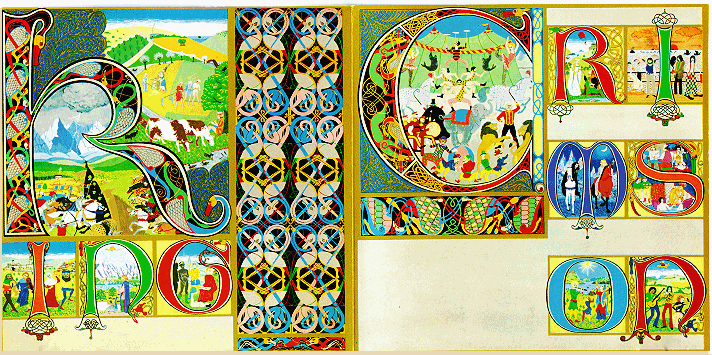
    The song Happy Family is a wonderful parody of the Beatles. You should take the time to read the lyrics and inspect closely the little picture in the upper right corner of the album cover behind the letter "I". The one with the yellow submarine in the background.

    In a recent diary entry at the DGM website, Fripp made some less than positive comments about this album, although he speaks highly of the track Bolero. He concludes that he knows that there are some Lizard-lovers out there, but that they must be really weird people. Thank you, Robert.

  4. Islands - 1971

    1. Formentera Lady
    2. Sailor's Tale
    3. The Letters
    4. Ladies of the Road
    5. Prelude: Song of the Gulls
    6. Islands

      Personnel:
    • Robert Fripp guitar, mellotron, Peter's Pedal Harmonium, and sundry instruments
    • Mel Collins flute, bass flute, saxes & vocals
    • Boz Burrel bass, lead vocals and choreography
    • Ian Wallace drums, percussion and vocals
    • Peter Sinfield words, sounds & visions

    • with:
      Keith Tippet piano
      Paulina Lucas soprano
      Robin Miller oboe
      Mark Charig cornet
      Harry Miller string bass

    Notes: That's the Trifid Nebula on the cover. Suggests a broader meaning of the word "Islands", doesn't it?

    The Letters is a re-working of the theme from Drop In, a tune performed live (but not recorded in the studio) by Crim the Great.

  5. Larks' Tongues in Aspic - 1973

    1. Larks' Tongues in Aspic, Part One
    2. Book of Saturday
    3. Exiles
    4. Easy Money
    5. The Talking Drum
    6. Larks' Tongues in Aspic, Part Two

      Personnel:
    • Robert Fripp guitar, mellotron & devices
    • David Cross violin, viola, mellotron
    • John Wetton bass & vocals
    • Bill Bruford drums
    • Jamie Muir percussion & allsorts

    • lyrics by Richard Palmer-James.

    Notes: Two words: Magical Enigma. While the sound is markedly different from the early incarnation of KC, this powerful album more than makes up for the lack of direction on Islands. This album broke new ground in music. Indeed, this album created entirely new categories of music. John Wetton and Bill Bruford join the team, giving the group the strongest line-up since the departure of McDonald, Giles, & Lake. I wish I knew the story behind the album title.

    Someone (I think a subscriber of the Elephant Talk Newsletter) has stated that King Crimson has made three really important albums: In the Court of the Crimson King, Lark's Tongues in Aspic, and Discipline. My own feeling is that these three albums are indeed instances of the most radical departures from the music that preceeded them (especially the first two of these), but that in no way diminishes the importance or quality of the other albums. I can't say enough how Lark's Tongues in Aspic is a stunning original creation, and yet, I feel that In the Wake of Poseidon, Lizard, Starless & Bible Black, Red, The ConstruKction of Light, and, to a lesser extent, Islands, Beat, Three of a Perfect Pair, Vrooom, and Thrak are every bit as important as musical events.

  6. Starless and Bible Black - 1974

    1. The Great Deceiver
    2. Lament
    3. We'll Let You Know
    4. The Night Watch
    5. Trio
    6. The Mincer
    7. Starless and Bible Black
    8. Fracture

      Personnel:
    • Robert Fripp guitar, mellotron & devices
    • David Cross violin, viola, keyboards
    • John Wetton bass & vocals
    • Bill Bruford percussives

    • lyrics by Richard Palmer-James.

    Notes: In my shifting, boiling kettle of favorite Crim albums, this one comes to the top perhaps more often than any other. Fripp, Wetton, Cross & Bruford are at their tightest. While not as much as a departure as the previous album, it is incredibly versatile. It has biting sarcasm (The Great Deceiver), heavy rockers with searing guitar work (The Great Deceiver, Lament), An intelligent ballad (The Night Watch - It has done more to make me appreciate the Rembrandt masterpiece than the painting itself!), a foray into classical sounding music with a hauntingly simple structure (Trio), brooding, discordant mystery (The Mincer), masterful syncopated rythmic displays (We'll Let You Know), and bold extended improvisational instrumentals (Starless & Bible Black, Fracture). What more can one expect?

  7. Red - 1974

    1. Red
    2. Fallen Angel
    3. One More Red Nightmare
    4. Providence
    5. Starless

      Personnel:
    • Robert Fripp guitar, mellotron
    • John Wetton bass and voice
    • Bill Bruford percussives

    • with:
      David Cross violin
      Mel Collins soprano saxophone
      Ian McDonald alto saxophone
      Robin Miller oboe
      Marc Charig cornet

    • lyrics by Richard Palmer-James.

    Notes: A worthy farewell album. It features the best of the Fripp-Wetton-Bruford sound in all it's perfectionism, but also integrates the sound of past incarnations: witness the personnel featuring guest artists from the 1969-1972 period! Providence reminds me of Moonchild somewhat - a very ambitious improvisation that works quite well. Fallen Angel recalls Pictures of a City in its sentiment, but not in its sound, which is unique although if one listens closely one can pick out sounds which evoke bits and pieces of every previous album. Starless even features a mellotron again! And the instrumental Red has even been adopted and reworked by the most recent incarnation of the band in the 90's.

  8. Discipline - 1981

    1. Elephant Talk
    2. Frame by Frame
    3. Matte Kudasai
    4. Indiscipline
    5. Thela Hun Ginjeet
    6. The Sheltering Sky
    7. Discipline

      Personnel:
    • Robert Fripp guitar & devices
    • Adrian Belew guitar & lead vocals
    • Tony Levin bass, stick, support vocals
    • Bill Bruford batterie

    Notes: My heart leaped when I saw a new KC album in the record bins! The sound is quite different from the previous incarnations. But quite good - they "Belew" me away! OK, I do occasionally miss the mellotrons, and prefer the Sinfield/Palmer-James lyrics to those of Belew on the whole, and yet this band is still the epitome of music for me. And the album? ...No matter how you analyze it, now matter how you break it down, it remains consistent. I LIKE IT!

    Thela Hun Ginjeet is an anagram for Heat in the Jungle. They opened their Nov. 17, 1995 concert in Springfield, MA with this cut. Despite my decades of admiration for this band, it was the first time I actually saw them in concert. Fulfillment of a lifelong dream.

  9. Beat - 1982

    1. Neal & Jack & Me
    2. Heartbeat
    3. Sartori In Tangier
    4. Waiting Man
    5. Neurotica
    6. Two Hands
    7. The Howler
    8. Requiem

      Personnel:
    • Robert Fripp guitar, organ, Frippertronics
    • Adrian Belew guitar & lead vocals
    • Tony Levin bass, stick, support vocals
    • Bill Bruford drumming

    Notes: In a Deja Vu (or should I say Deja Vrooom?) experience which mirrored my experience with the first incarnation of KC, it was actually the second album (Beat) which I heard prior to the first (Discipline). Like eleven years previously, I found myself defending the second album to people who claimed the first was better. Perhaps they are right, but my experience is more akin to my experience with the first incarnation in another way (which I take as independent evidence of the greatness of this band); namely that my favorite album (and song) with this line-up also remains in a state of perpetual flux.

    Despite the more pop-oriented lyrics of Adrian Belew, there are some very interesting features worthy of note. The opening cut Neal & Jack & Me is of course a tribute to the Beat Generation by it's reference to Neal Cassady and Jack Kerouac's antics in the classic On the Road. But what an interesting twist - the song is sung from the perspective of the car(!) that they drove. (A thematic trick which would appear again on the next album). Similarly, Two Hands, a hauntingly beautiful love song is sung from the perspective of a photograph on the wall whose subject is observing two lovers intertwined as one. Other notable lyrics of Belew on this album are the almost commercially viable ballad heartbeat (which was covered years later by Al Kooper on his live album Soul of a Man) and the psychotic rap-like Neurotica, a sort of modern day update of Pictures of a City.

  10. Three of a Perfect Pair - 1984

    1. Three of a Perfect Pair
    2. Model Man
    3. Sleepless
    4. Man With an Open Heart
    5. Nuages (That Which Passes, Passes Like Clouds)
    6. Industry
    7. Dig Me
    8. No Warning
    9. Larks' Tongues in Aspic, Part III

      Personnel:
    • Robert Fripp guitar
    • Adrian Belew guitar & lead vocals
    • Tony Levin bass, stick, synth & support vocals
    • Bill Bruford acoustic and electric drumming

    Notes: The title cut has to be one of the best examples of Belew's lyrics and is one of my favorite songs by this incarnation of KC. Dig me is the cut sung from the perspective of a (discarded, rusting, rotting) automobile. The entire album is quite enjoyable, but the surprise ending would warm the heart of any true Crimhead - Larks' Tongues in Aspic, Part III, a tribute to the landmark album from the 70's incarnation of KC. Will There be a part IV? (Yes! see below!)
    Thankfully, this album marks the last Crim album to be printed on vinyl. The Compact Disc is the only medium worthy of the music from the phenomenom known as King Crimson. (Please, all vinyl aficionados, refrain from spamming me for this one!)

  11. Vrooom - 1994

    1. VROOOM
    2. Sex Sleep Eat Drink Dream
    3. Cage
    4. Thrak
    5. When I Say Stop, Continue
    6. One Time

      Personnel:
    • Robert Fripp guitar
    • Adrian Belew guitar, voice, words
    • Trey Gunn stick
    • Tony Levin basses and stick
    • Pat Mastelotto acoustic & electric percussions
    • Bill Bruford acoustic & electric percussions

    Notes: They're back! Besides the new "double trio" lineup, this incarnation brought me my first chance to see them in concert. Much of this album was expanded in the next offering Thrak. Of those cuts which didn't make it onto Thrak, Cage is notable in its intensity and in that it recalls Neurotica somewhat.

  12. Thrak - 1995

    1. VROOOM
    2. Coda: Marine 475
    3. Dinosaur
    4. Walking on Air
    5. B'Boom
    6. THRAK
    7. Inner Garden I
    8. People
    9. Radio I
    10. One Time
    11. Radio II
    12. Inner Garden II
    13. Sex Sleep Eat Drink Dream
    14. VROOOM VROOOM
    15. VROOOM VROOOM: Coda

      Personnel:
    • Robert Fripp guitar, soundscapes, mellotron
    • Adrian Belew guitar, voice, words
    • Trey Gunn stick, backing vocals
    • Tony Levin upright and electric basses
    • Pat Mastelotto acoustic & electric percussions
    • Bill Bruford acoustic & electric percussions

    Notes: After the short mini-album VROOOM, this offering was a welcome addition to my collection, even though much of VROOOM reappears. It's an hour of the most intense original music of 1994.
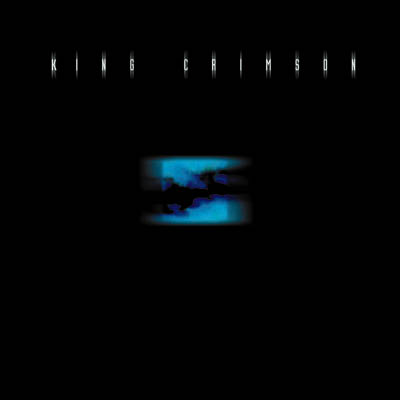
  13. The ConstruKCtion of Light - 2000

    1. ProzaKc Blues
    2. The ConstruKction of Light
    3. Into the Frying Pan
    4. FraKctured
    5. The World's My Oyster Soup Kitchen Floor Wax Museum
    6. Larks' Tongues in Aspic - Part IV
    7. Coda: I Have a Dream
    8. Heaven and Earth (ProjeKCt X)

      Personnel:
    • Robert Fripp guitar
    • Adrian Belew guitar, vocals
    • Trey Gunn bass touch guitar, baritone guitar
    • Pat Mastelotto drumming

    Notes: This was the result of 3 years of 'research and development' by the ProjeKCts - a leaner, stripped down, more guitar-oriented incarnation of King Crimson. To me, it is much more satisfying than anything produced by the double trio. While not everyone agrees with this sentiment, and indeed this was a somewhat controversial release (partly because of the tunes 'FraKctured' and 'LTIA part IV', which were seen by some as too much reliance on past glories), I nevertheless like this better than anything they've done since Red. Indeed the two tunes mentiond above are my favorites on the album, and I applaud the return to interlocking guitar parts and world class guitar work from Fripp on 'FraKctured', which I regard not as an exercise in nostaglia (cf. 'Fracture' on Starless and Bible Black), but as the next natural step in the evolution of an idea. And Adrian's imitation of Tom Waits on 'ProzaKc Blues', whether intentional or not, is a hoot.

    Also I like this album more than the double trio partly because the double trio is too dense. With 6 world class musicians playing at once, it is too crowded for any one to really step out, and it would be difficult to hear and follow individual parts if they did anyway. There is more than enough going on at once with just these four guys playing!

The rest of the KC catalog consists of "best of" collections and various box sets. In this section, rather than be encylcopaedic, I note only those which I have actually heard and/or purchased. For live albums, see the next page.
Page 2. (Live albums and Collector's Club)

Page 3. (ProjeKCts and related releases)

Return to my music page:

Crimheads have just dropped in since 7/1/2001.
(and over 350 hits between 1/8/98 & 6/30/2001.)

Last modified: 8/25/2001